October 2008
Monthly Archive
Monthly Archive
Posted by Jim Bridges on Oct 30, 2008 at 07:00 am
Tagged as: Frogs & amphibians, The Digital Frog 2.5
 Do you know of an outstanding middle or high school student or teacher who has made strides to replace dissection with humane, non-animal teaching methods or who has implemented or expanded a dissection choice policy?
Do you think they (and their science department) might appreciate $1000 each for their efforts?
Then the Physician’s Committee for Responsible Medicine wants to nominate him or her for one of two 2009 Cut Above Awards for Dissection Alternatives. From their release:
The winning student and educator will each receive $2,000, which includes $1,000 for each recipient and $1,000 for their schools.
Any high school or middle school teacher or student who has made significant moves to replace dissection in primary or secondary schools with humane, non-animal alternatives is eligible to receive an award. Please also make biology teachers at your school aware of this opportunity.
PCRM is a nonprofit organization with a membership of 6,000 physicians and more than 100,000 other medical professionals, scientists, educators, and laypersons. PCRM conducts clinical research, promotes preventive medicine, and seeks higher ethical and scientific standards in research and education. To that end, we urge educators to eliminate harmful animal use, including dissection, in favor of validated non-animal learning methods.
A growing number of students and educators realize that non-animal learning methods teach concepts of anatomy and biology just as well or better than traditional dissection. These non-animal methods also teach students to value and respect all life forms and can save schools money.
You can submit your nomination online. (They even say that self-nominations by students and teachers are not only welcomed, but encouraged.) Nomination deadline is December 1, 2008.
Posted by Celia Clark on Oct 07, 2008 at 08:00 am
Tagged as: Digital Field Trips, Digital Frog International
My role as President of Digital Frog International and a very large garden to be cared for do not leave me much time for vacationing. However, last week, we took a few days off and headed up to Algonquin Park with some friends who are visiting from England.
For once, the weather gods were on our side and we managed to catch the fall colors at their peak, But perhaps the most special experience for me was finally getting to visit Cloud Lake. Of course I have visited it digitally hundreds of times as it is the location for The Digital Field Trip to The Wetlands, but this was the first time I had actually been there.
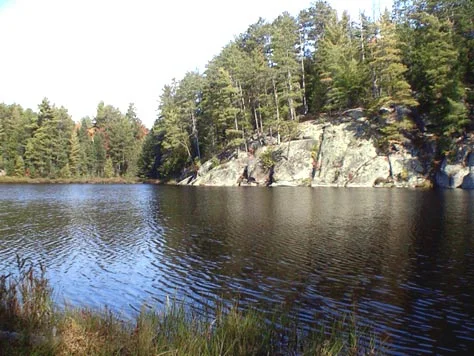
Our developers chose the location for several reasons, not the least being the stunning scenery, which is even more beautiful in the fall. With clear blue skies and incredible colors, it was an unforgettable experience. Perhaps the most surreal experience is listening to the loons. My ever patient brother-in-law spent hours on Little Joe Lake patiently filming a surprisingly bold loon, capturing its eerie cry on tape.
Get the Flash Player to see this content.
As the name implies, Cloud Lake is at a fairly high elevation on the Centennial Ridges Trail, so it was a somewhat challenging climb for my poor old body, but worth every aching bone! Our goal was to secrete a metal box with several copies of The Digital Field Trip to The Wetlands for intrepid geocachers to locate using GPS technology. If you do not know about geocaching, check out www.geocache.com – it is a great way to discover out-of-the way gems that most people never find and a fabulous way to teach children about geography and nature. And plan to visit Cloud Lake soon. We intend to keep the cache stocked with CDs.
Posted by Celia Clark on Oct 05, 2008 at 08:42 am
Tagged as: Digital Frog International
Today is International Teachers Day – this got me thinking about my checkered career as an educator and how much teaching has changed over the last half century.
I trained as an elementary teacher in England in the sixties and was in the first cohort of three-year trainees. I majored in English Literature and avoided the sciences whenever I could, but as a junior school teacher had to teach everything including music (and I’m tone deaf!). My most vivid memory of my three years isolated in an old English castle learning the craft of teaching was an elderly professor thumping on the table and saying “If you say you are going to kill a child, you MUST kill that child”. That woke me up! Of course, what she was saying was that you should never threaten a child with a punishment you have no intention of carrying out – some of today’s parents would do well to remember that shocking advice!
I remember one practicum when I had to teach photosynthesis to a class of unruly eleven-year olds. The truth is I did not really understand it myself – but stayed up all night trying to create a large poster that would help the students (and me) understand the process. Which leads me to muse on the incredible visual aids available to today’s teachers. With overhead projectors, interactive whiteboards, the internet and computer resources such as Digital Frog’s natural science software, no teacher needs to stay up all night struggling to create third-rate visual aids.
Truthfully, I never did get to grips with photosynthesis until I was editing the text for Photosynthesis in The Digitial Field Trip the The Wetlands. The excellent animations make it much easier to understand the basic process, while offering details for the older students – they can even click to view the molecular structure of the chemicals – and I did have one bright student in that class long ago who would have lapped up that information.
Of course, that is another advantage of technology-enabled learning tools; they cater to multiple intelligences and learning styles and allow slower learners to work at their own pace, while quick learners can continue to delve deeper and are less likely to disrupt the class.
One change that I personally think is not an improvement is that teaching, at least in North America, has become very prescriptive. Whenever the politicians get any flack about the educational achievements of students, they try and fix the problem by passing legislation such as No Child Left Behind. These mandates are almost always underfunded and impose more bureaucracy and strain on already overloaded teachers, while not improving the overall education.
I was lucky enough to teach in an era when teachers were considered to be professionals who could decide what and how to teach as long as the students left elementary school having mastered the “3 Rs” – reading, (w)riting and (a)rithmetic with exposure to the sciences and the arts. If there was an eclipse of the sun, we would drop everything else and teach everything around this exciting event – we’d find stories and poems that featured thsi mystical event as well as teaching the science (again, with inexpert drawings and posters! The administration understood that not all students could achieve the same academic levels and we were expected to accommodate the multiple strengths and weaknesses.
Although I have not been teaching in the classroom for many years (I moved into corporate training, technical writing and then software development), it seems to me that today’s teachers are so¬† pressured by¬† the prescriptive curriculum that teaching today is even more challenging than when I was teaching, in spite of the incredible teaching tools available to them.
What do YOU think?
Posted by Tracie Treahy on Oct 02, 2008 at 09:52 am
Tagged as: Digital Frog International, Digital Frog software
Well the cooler nights and crisper mornings has me thinking about fall and the back to school routine. As marketing coordinator at Digital Frog International, working on the back to school specials got me remembering that favorite time of year (especially for parents!) We each treasure memories from our own school days and the beginning of a new school year. I remember being so hot on the first day of school because I would insist on wearing my new fall school outfit even though it was 80 degrees out!
My daughters were always excited about the new school year, wondering who would be in their class, did they get the teacher they hoped for and of course how would they look in the new school outfit! We all look forward to the shopping trip for new binders, pens, pencils and of course stylish new clothes. In the interest of recycling and reusing we tried not to buy everything new each year though I gave up trying to make my children reuse the markers and colored pencils from one year to the next even though they were barely used, the old ones became the home work set and the new ones went off to school. My girls loved organizing the new binders with paper and dividers and they swore every new year to stay neat and organized in their books(usually that lasted the first 2 weeks)
My daughters have very diverse interests and have chosen very different paths in school. We had a surprise from one of our daughters when she went into science at college. Science was not of any interest to her in high school and after spending her summer working for Digital Frog International testing the new versions of our science programs SciencMatrix: Cell Structure and Function and The Digital Frrog 2.5 she had her interest piqued in anatomy and biology and is now working towards a career in the science field.
Our family will be celebrating the beginning of school for many more years as only one of our four girls has graduated from post secondary education.