July 2009
Monthly Archive

Monthly Archive
Posted by Tracie Treahy on Jul 22, 2009 at 09:00 am
Tagged as: Digital Frog International
Well I have the luxury of bringing my dogs to work with me at Digital Frog International. I think this is a blessing, but some days I am not so sure.
We had a canine team of three when Widgett, my Border Collie X pup, started coming to work with me. He joined Whiskey, a 12 year old German Shepherd and Dudley a one year old Golden Retriever. Whiskey was the office boss and took this job seriously (as any boss does) reminding the young guys to stay in line and out of her spot. Whiskey is the dog made “famous” in Digital Frog software, she is featured in the eyeshine section of The Digital Field to The Rainforest and, randomly on various Quit screens in the other programs. Sadly this spring Whisley’s age caught up with her and she is no longer patrolling our office and preventing the planes from landing on the property.

We run an educational software company and when customers call the office they can often hear the dogs “chatting” to us or to each other in the background. Dudley is very vocal and “talks” to his friends to get them to play. When not allowed to do as he pleases Dudley will think nothing of standing his ground and giving us his best back-talking woofs, and as with a toddler in trouble it is hard to not to laugh at his back barking.
With two pups in the office things aren’t always safe. A favorite thing to steal is the bubble wrap from the shipping department and just like kids they like to pop all the bubbles.
I spend a chunk of my day stepping over, around and on dogs! The young dogs love to lie under my desk and chair so I have run over stray ears,tails and feet on more than one occasion.
With Whiskey gone, a new dog was adopted from the local Humane Society for the Digital Frog security team. A handsome two year old Shepherd cross named Kado who now calls us his family. I can now bring my older dog Beemer (a clash with Whiskey) to work as well.
The canine team of four is a good one, one dog for notifying us to the imaginary cars driving up and the other three for reinforcements in case no one is really there!!
We have some messy moments, like when Dudley decided to go visiting the neighbors, uninvited. He had to have a swim in their pond and he likes to swim under water.I was so happy to find him up the road until I realized I would have my own Digital Field trip to the Wetlands in my car once he jumped in. Being a dog lover gave me no choice but to invite him into my car, sopping wet, covered in duck weed, algae and smelling like a swamp beast.
Some days are not as productive as others in our office; it depends what the dogs have on the agenda for the day. We laugh at the dogs everyday and some days wonder what we were ever thinking having four dogs, getting in the way causing mayhem and havoc. If you call our office and it sounds like a kennel, remember it is our dogs in the office.
Posted by Celia Clark on Jul 01, 2009 at 12:00 pm
Tagged as: Environmental issues, Frogs & amphibians, The Digital Frog 2.5
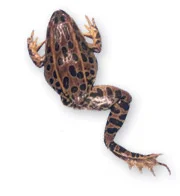 A few days ago, Jim, our webmaster, sent me a link to an article from the BBC about recent research on the “mystery of the missing frog legs“. For years there has been a common belief that various environmental factors play roles in the widespread and increasingly common deformities, such as missing legs, being found in frog populations.
We believed this to be such a fundamental topic in teaching about frog ecology that we even dedicated an entire screen in The Digital Frog 2.5‘s ecology section to the issue. On the page about environmental concerns, we wrote:
Many scientists consider frogs important bio-indicators. Frogs have permeable skin and live both on land and in water. As a result, environmental problems quickly affect frogs.
Recently, frog populations have declined or disappeared around the world, and deformities and mutations are becoming common. People have found adult frogs with misshapen bodies, extra legs, missing or abnormal organs, and even eyes growing inside mouths!
Frog deformities, mutations and declining populations are not likely to result from any single cause; it is much more probable that many factors affect our amphibian friends. Scientists have identified holes in the ozone layer, chemicals, pollution, habitat loss and frog harvesting as possible causes.
Laboratory tests with ultraviolet light have produced frogs with leg deformities. Scientists speculate that holes in the ozone layer may allow enough ultraviolet light through to affect frogs in the wild.
Amphibian skin absorbs chemicals from both land and water. Tests show that some chemicals, pesticides, and industrial pollutants cause mutations, abnormal growth, or fatal deformities in frogs.
Industrial and agricultural by-products can harm local frogs. Acid rain and runoff rain can carry these chemicals to places far removed from human habitation.
Habitat loss is probably the biggest single factor in declining frog populations. Wetlands are frequently drained, filled in, or otherwise destroyed, depriving frogs of places to live. Commercial harvesting is another pressure.  Worldwide, hundreds of thousands of frogs are captured each year and used in laboratories, schools, and restaurants; this causes serious declines in certain species.
We used four frogs in the original Digital Frog, and none had deformities. This version required five frogs, and we discovered internal deformities in three of them.
New research suggests that there are two more natural causes contributing to frog deformities:
1. The fungal condition chytridiomycosis which has brought rapid extinctions to some amphibians.
2. The deformed frogs are actually victims of the predatory habits of dragonfly nymphs, which eat the developing hind limbs of tadpoles! Remarkably many tadpoles seem to survive the ordeal, resulting into as much as 10% of frog populations missing limbs. You can read more on the BBC’s Earth News page (and even watch the video evidence of one hapless tadpole being made a victim by a dragonfly nymph).
In other frog research news, yet another recent study suggests that up to one billion frogs are taken from the wild for human consumption each year. Not to mention the millions of frogs that are cut up every year in schools around the world. No wonder frogs are used as the poster children of the natural world!