
“Mr. Dragonfly Nymph in the swamp with a pair of mandibles.” Is the mystery of the missing frog legs finally solved?
Posted by Celia Clark on Jul 01, 2009 at 12:00 pm
Tagged as: Environmental issues, Frogs & amphibians, The Digital Frog 2.5
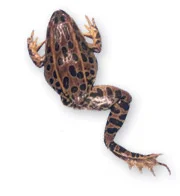 A few days ago, Jim, our webmaster, sent me a link to an article from the BBC about recent research on the “mystery of the missing frog legs“. For years there has been a common belief that various environmental factors play roles in the widespread and increasingly common deformities, such as missing legs, being found in frog populations.
We believed this to be such a fundamental topic in teaching about frog ecology that we even dedicated an entire screen in The Digital Frog 2.5‘s ecology section to the issue. On the page about environmental concerns, we wrote:
Many scientists consider frogs important bio-indicators. Frogs have permeable skin and live both on land and in water. As a result, environmental problems quickly affect frogs.
Recently, frog populations have declined or disappeared around the world, and deformities and mutations are becoming common. People have found adult frogs with misshapen bodies, extra legs, missing or abnormal organs, and even eyes growing inside mouths!
Frog deformities, mutations and declining populations are not likely to result from any single cause; it is much more probable that many factors affect our amphibian friends. Scientists have identified holes in the ozone layer, chemicals, pollution, habitat loss and frog harvesting as possible causes.
Laboratory tests with ultraviolet light have produced frogs with leg deformities. Scientists speculate that holes in the ozone layer may allow enough ultraviolet light through to affect frogs in the wild.
Amphibian skin absorbs chemicals from both land and water. Tests show that some chemicals, pesticides, and industrial pollutants cause mutations, abnormal growth, or fatal deformities in frogs.
Industrial and agricultural by-products can harm local frogs. Acid rain and runoff rain can carry these chemicals to places far removed from human habitation.
Habitat loss is probably the biggest single factor in declining frog populations. Wetlands are frequently drained, filled in, or otherwise destroyed, depriving frogs of places to live. Commercial harvesting is another pressure.  Worldwide, hundreds of thousands of frogs are captured each year and used in laboratories, schools, and restaurants; this causes serious declines in certain species.
We used four frogs in the original Digital Frog, and none had deformities. This version required five frogs, and we discovered internal deformities in three of them.
New research suggests that there are two more natural causes contributing to frog deformities:
1. The fungal condition chytridiomycosis which has brought rapid extinctions to some amphibians.
2. The deformed frogs are actually victims of the predatory habits of dragonfly nymphs, which eat the developing hind limbs of tadpoles! Remarkably many tadpoles seem to survive the ordeal, resulting into as much as 10% of frog populations missing limbs. You can read more on the BBC’s Earth News page (and even watch the video evidence of one hapless tadpole being made a victim by a dragonfly nymph).
In other frog research news, yet another recent study suggests that up to one billion frogs are taken from the wild for human consumption each year. Not to mention the millions of frogs that are cut up every year in schools around the world. No wonder frogs are used as the poster children of the natural world!