
Rainforest animal fact file: The Jaguar
Posted by Celia Clark on May 06, 2010 at 12:18 pm
Tagged as: Digital Frog International
Our educational software is chock-full of information on organisms from around the world that we’d like to share here as well. This is all about jaguars, taken from The Digital Field Trip to The Rainforest program.
THE JAGUAR
The word “jaguar” comes from “yaguar,” meaning “he who kills with one leap.” Also known as “El Tigre,” the jaguar is the largest cat in the New World. A jaguar can be as long as 2 m (6 ft), and weigh over 140 kg (300 lbs). Its only predators are the anaconda and humans.
However, habitat loss and hunting have had a dramatic effect on jaguar populations, bringing jaguars close to extinction. The jaguar reserve in Belize is the first of its kind.
Habitat
The jaguar lives in both lowland and mountain forests, by rivers, in jungles, savannas, mangrove swamps and moist forests. It prefers damp areas, tracking prey by their footprints.
Each jaguar lives alone, but home ranges frequently overlap.
Behavior
The jaguar is nocturnal, stalking prey silently. Its beautiful spotted coat provides camouflage, helping it sneak up on prey. It is a good swimmer and can turn its front paws inward to help it grab prey.
Like most cats, it has good hearing and retractable claws. It can roar, but not purr, and its eyes close to circles, not slits. It has excellent sight, sees color and, at night, sees six times better than a human.
Life Cycle
A female jaguar gives birth to two or three young after a three month pregnancy.
Offspring are born blind and helpless. They stay with their mother for one year, but do not fully mature for three years and can live up to 20 years.
Food Source
The jaguar is a carnivore and hunts vertebrates. When it attacks, it pounces on the head or neck, and attempts to snap the spine.
A jaguar eats almost everything from a kill, including most of the bones. It uses its side teeth to chew, because the front teeth are normally weak.
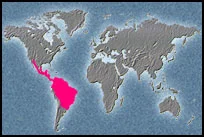
Range
Jaguars can be found in the following areas…
For more information on the jaguar and other rainforest plants and animals, take a look at The Digital Field Trip to the Rainforest. Or download a free demo of the program here.