Digital Frog software
Archived posts from this Category
Archived posts from this Category
Posted by Jim Bridges on Apr 30, 2010
It’s April 30, which means it is Save the Frogs Day once again.
Just a reminder that to mark the occasion, we’re having a one day only, Save the Frogs Day sale.
Until midnight tonight, you can save 25% off any Digital Frog 2.5 license, plus we will donate 25% to the Save the Frogs Foundation.
Orders must be placed through our online store.
And to find out what else is going on on Save the Frogs Day, be sure to check out the Save the Frogs Day web site.
Posted by Celia Clark on Mar 11, 2010
 We are delighted to announce that Digital Frog products have been approved and are now available through the TIPS/TAPS Purchasing Cooperative with an anytime discount of 10%.
The Purpose of TIPS/TAPS is to:
• Provide school districts and other governmental entities opportunities for greater efficiency and economy in acquiring goods and services.
• Provide quick and efficient delivery of goods and services by contracting with “high performance” vendors.
• Equalize purchasing power for smaller entities that are not able to command the best contracts for themselves.
• Maintain credibility and confidence in business procedures by maintaining open competition for purchases and by complying with purchasing laws and ethical business practices.
• Assist entities in maintaining the essential controls for budget and accounting purpose.
This means that members can order with confidence knowing that all purchasing requirements have already been completed during the RFP process, saving the time and expense associated with competitively bidding each purchase.
Ordering is simple:
1. Create a purchase order (use your district’s normal procedure). Be sure to write or type in DIGITAL FROG somewhere on the purchase order. If you want product shipped by courier please include your EIN number (federal tax id) for US Customs.
2. FAX the purchase order to TIPS/TAPS at 866-839-8472
3. Digital Frog will apply the 10% discount and ship your order within 2-5 business days.
Posted by Jim Bridges on Mar 04, 2010
I’ve been trying to come up with a pithy little introduction here, but really all we wanted to share is that we’ve put together a short(ish) movie as an introduction to Digital Frog International’s educational software programs. We think it does a pretty good job explaining what you get with a DFI program, the range and depth of topics we cover and why you and your students can benefit from our software.
So grab some popcorn, but your feet up for a few minutes and let us show you what you get with a Digital Frog product. And if you’re really inspired, you can head over to our DemoWare pages to get your free demo versions to try for yourself.
(If you’ve never checked out the Digital Frog YouTube channel, you can find a growing number of videos, from sample dissection videos from The Digital Frog 2.5 to the shockingly popular time-lapse of a decomposing rabbit, with more going up in the coming months.)
Posted by Celia Clark on Nov 25, 2009
Earlier this year, PETA partnered with pathologist Dr. Nancy Harrison to produce a short video with highlights of The Digital Frog 2.5. We first met Nancy a few years ago when she was presenting her research on dissection alternatives to science teachers in San Diego.
We could not help wondering why a practicing pathologist, who dissects human tissue for a living, would be taking the time to research dissection alternatives. This is what she says on the Dissection Alternatives website hosted by the Physicians Committee for Responsible Medicine website:
“As a pathologist, I perform careful dissections every day‚ on human tissues, not on animals. It’s my job to know the relationship between anatomy and physiology, between health and disease.
But it wasn’t the frog or cat dissections we performed in public school that inspired me to study science. It was my excellent science teachers! The energy they poured into our classrooms, the academic heights they challenged us to reach, and their own bright intellects drew me into this field.
Decades later, I’ve come to regret those dissections and have since studied computerized alternatives that are extremely comprehensive. As a doctor who performs autopsies, I can assure students that computer images of well-preserved tissues look more like the “real thing” than the squishy gray organs of a formalin-fixed specimen. Simulated dissection is very realistic, the accompanying text is elegant, and the graphics are superb. Computerized alternatives are rapidly replacing animals in medical and veterinary colleges across the country. And the same is true at earlier levels of training. That means that younger students can easily learn biology by taking advantage of state-of-the-art methods that do not involve dissecting at all. My heartfelt gratitude goes out to science teachers everywhere who are creating a passion for humane scientific study. Tomorrow’s great physicians and researchers depend on it.”
We were not involved in the production of this video, but are thrilled with all that Nancy has to say about our program, The Digital Frog 2.5 and that she is one of our biggest supporters and proponents. And Nancy will not even allow us to buy her a cup of coffee!
We find it interesting that The Digital Frog 2.5 has also been voted the best dissection alternative by eSchool News readers. However, we created the program to teach anatomy and physiology, not dissection skills. We included the dissection module to bridge the gap between the traditional way of teaching anatomy and physiology and the 21st century way – better, kinder and much more cost effective way.
And one thing that Nancy does not mention is that schools can save huge amounts of money by teaching anatomy and physiology with The Digital Frog instead of with wet labs and textbooks. We have just returned from a science teachers conference in Texas. One middle school principal, who purchased a Building Site License for The Digital Frog 2.5 last year, stopped by our booth to say that he has already saved $1,200! You’ll be amazed at the cost savings, especially for large schools.
Posted by Celia Clark on Jul 01, 2009
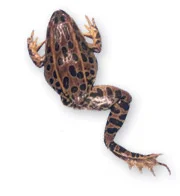 A few days ago, Jim, our webmaster, sent me a link to an article from the BBC about recent research on the “mystery of the missing frog legs“. For years there has been a common belief that various environmental factors play roles in the widespread and increasingly common deformities, such as missing legs, being found in frog populations.
We believed this to be such a fundamental topic in teaching about frog ecology that we even dedicated an entire screen in The Digital Frog 2.5‘s ecology section to the issue. On the page about environmental concerns, we wrote:
Many scientists consider frogs important bio-indicators. Frogs have permeable skin and live both on land and in water. As a result, environmental problems quickly affect frogs.
Recently, frog populations have declined or disappeared around the world, and deformities and mutations are becoming common. People have found adult frogs with misshapen bodies, extra legs, missing or abnormal organs, and even eyes growing inside mouths!
Frog deformities, mutations and declining populations are not likely to result from any single cause; it is much more probable that many factors affect our amphibian friends. Scientists have identified holes in the ozone layer, chemicals, pollution, habitat loss and frog harvesting as possible causes.
Laboratory tests with ultraviolet light have produced frogs with leg deformities. Scientists speculate that holes in the ozone layer may allow enough ultraviolet light through to affect frogs in the wild.
Amphibian skin absorbs chemicals from both land and water. Tests show that some chemicals, pesticides, and industrial pollutants cause mutations, abnormal growth, or fatal deformities in frogs.
Industrial and agricultural by-products can harm local frogs. Acid rain and runoff rain can carry these chemicals to places far removed from human habitation.
Habitat loss is probably the biggest single factor in declining frog populations. Wetlands are frequently drained, filled in, or otherwise destroyed, depriving frogs of places to live. Commercial harvesting is another pressure.  Worldwide, hundreds of thousands of frogs are captured each year and used in laboratories, schools, and restaurants; this causes serious declines in certain species.
We used four frogs in the original Digital Frog, and none had deformities. This version required five frogs, and we discovered internal deformities in three of them.
New research suggests that there are two more natural causes contributing to frog deformities:
1. The fungal condition chytridiomycosis which has brought rapid extinctions to some amphibians.
2. The deformed frogs are actually victims of the predatory habits of dragonfly nymphs, which eat the developing hind limbs of tadpoles! Remarkably many tadpoles seem to survive the ordeal, resulting into as much as 10% of frog populations missing limbs. You can read more on the BBC’s Earth News page (and even watch the video evidence of one hapless tadpole being made a victim by a dragonfly nymph).
In other frog research news, yet another recent study suggests that up to one billion frogs are taken from the wild for human consumption each year. Not to mention the millions of frogs that are cut up every year in schools around the world. No wonder frogs are used as the poster children of the natural world!
Posted by Celia Clark on Mar 20, 2009
While the economy is currently on everyone’s mind, several recent United States federal funding initiatives for education technology totaling almost $6 billion will give a much needed boost.
The bulk of the funding is coming through the economic stimulus package. While the Education Department is cautioning school leaders that the stimulus marks a large, one-time increase in federal education funding‚ and they shouldn’t count on having this much funding every year‚ the funds are being billed as a “unique opportunity to make short-term investments with the potential for long-term benefits.”
The stimulus grants are intended to fund sustainable projects and activities that will improve teaching, learning, and educational outcomes for all students, and especially those with disabilities. And the funding may be coming sooner than later, according to the eSchool News:
“The first pool of money is for established formulas such as Title I, the Individuals with Disabilities Education Act (IDEA), and the Enhancing Education Through Technology (EETT) program. Federal officials will release the first half of these funds to state education departments by the end of March, and school systems should see this money by the end of April.”
Digital Frog International’s educational science software addresses several of the key areas the package is intended to fund and may be eligible under the stimulus package funding. Here are just some of the ways our software addresses the different areas being targeted:
| Funding support for: | How Digital Frog software qualifies: |
|
Individuals with Disabilities Education Act (IDEA) |
All Digital Frog programs are self-voicing and support visually impaired learners and those with learning disabilities. |
|
Enhancing Education Through Technology (EETT) |
Digital Frog products use technology extremely effectively to engage student interest and enhance learning. Context-sensitive definitions on every word support slow learners as well as ESL students. The effective use of multimedia and computer-based activities provides a stimulating learning environment and triggers a lifelong interest in the natural sciences. |
|
Title I‚ Improving |
The interface is primarily point-and-click with one-letter access to features such as text-to-speech, help and the fast find feature. Programs are multi-level and accommodate a wide range of learning styles. Slow learners appreciate the opportunity to learn at their own pace. |
| Short-term investments with the potential for long-term benefits |
Digital Frog Licensing is “in perpetuity”, meaning the license fee is paid only once when the program is purchased. There is no annual subscription fee. Workbook materials are included with the software and can be printed or modified as needed. With a Building Site License (BSL), you can: • run the software on an unlimited number of computers in the specified location, either across the network, installed on the hard drive, or you can make a copy of the CD for each machine. • make up to 20 copies of the CD for teachers and students to borrow for home use. |
Posted by Jim Bridges on Jan 01, 2009
For the month of January, we’re making one of our best deals even better by giving you a building site license of The Digital Frog 2.5 at $100 off the regular price. That is a license for our award-winning virtual frog dissection, anamtomy and ecology program for use on an unlimited number of computers at one site for just $799 instead of the regular $899 price.
Also included is a fully editable electronic version of the teacher and student workbook materials, as well as the rights to make up to 20 copies to loan out for home use.
And unlike some other virtual dissection software, this is a one-time license fee. There is no annual subscription fee. Once you have purchased The Digital Frog 2.5, you can use it in perpetuity, with as many students as require the program.
The special is available exclusively in our online store through January 31, 2009.
Posted by Jim Bridges on Dec 15, 2008
December is associated with the season of giving. And we’re using this December to launch our own way of giving to our customers: exclusive online monthly specials of Digital Frog International’s science software for both your classroom and home.
This month, we’re offering the home version of The Digital Field Trip Series DVD for just $66. That’s all three Digital Field Trips‚ÄîThe Wetlands, The Rainforest, and The Desert‚Äîat 33% off the already low regular price of the DVD, and over 50% off the price of buying all three field trips separately.
Normally, we charge $45 per title for each Digital Field Trip. For the month of December, for just $21 more you’ll get all three Digital Field Trips on one DVD, containing both the Windows AND Macintosh versions. There has never been a better and more affordable way to bring the wonders of the world’s ecosystems to your children than this.
The DVD is licensed for home use and contains full versions of all three Digital Field Trips in the series. Each field trip contains virtual-reality trips to the ecosystem to allow you and your children to visit it digitally, as well as a wealth of other modules covering everything from its plants and animals, the processes that keep it functioning, as well as more general natural science and geography topics in an fun, interactive and engaging way.
The Digital Field Trip to The Wetlands
Wetland ecology without getting your feet wet, including sections on food webs, nutrient cycles and photosynthesis.
The Digital Field Trip to The Rainforest
Rainforest ecology, from the rainforests of the world to interdependencies, botany and human impact.
The Digital Field Trip to The Desert
Deserts of North America and around the world, with in-depth sections on adaptations, homeostasis and landscape formation.
The special is available exclusively in our online store through December 31, 2008.
(You can also download free limited demo versions of all of the Digital Field Trips if you want to preview them before buying. But act fast, The offer ends at the end of the year.)
Posted by Jim Bridges on Oct 30, 2008
 Do you know of an outstanding middle or high school student or teacher who has made strides to replace dissection with humane, non-animal teaching methods or who has implemented or expanded a dissection choice policy?
Do you think they (and their science department) might appreciate $1000 each for their efforts?
Then the Physician’s Committee for Responsible Medicine wants to nominate him or her for one of two 2009 Cut Above Awards for Dissection Alternatives. From their release:
The winning student and educator will each receive $2,000, which includes $1,000 for each recipient and $1,000 for their schools.
Any high school or middle school teacher or student who has made significant moves to replace dissection in primary or secondary schools with humane, non-animal alternatives is eligible to receive an award. Please also make biology teachers at your school aware of this opportunity.
PCRM is a nonprofit organization with a membership of 6,000 physicians and more than 100,000 other medical professionals, scientists, educators, and laypersons. PCRM conducts clinical research, promotes preventive medicine, and seeks higher ethical and scientific standards in research and education. To that end, we urge educators to eliminate harmful animal use, including dissection, in favor of validated non-animal learning methods.
A growing number of students and educators realize that non-animal learning methods teach concepts of anatomy and biology just as well or better than traditional dissection. These non-animal methods also teach students to value and respect all life forms and can save schools money.
You can submit your nomination online. (They even say that self-nominations by students and teachers are not only welcomed, but encouraged.) Nomination deadline is December 1, 2008.
Posted by Celia Clark on Oct 07, 2008
My role as President of Digital Frog International and a very large garden to be cared for do not leave me much time for vacationing. However, last week, we took a few days off and headed up to Algonquin Park with some friends who are visiting from England.
For once, the weather gods were on our side and we managed to catch the fall colors at their peak, But perhaps the most special experience for me was finally getting to visit Cloud Lake. Of course I have visited it digitally hundreds of times as it is the location for The Digital Field Trip to The Wetlands, but this was the first time I had actually been there.
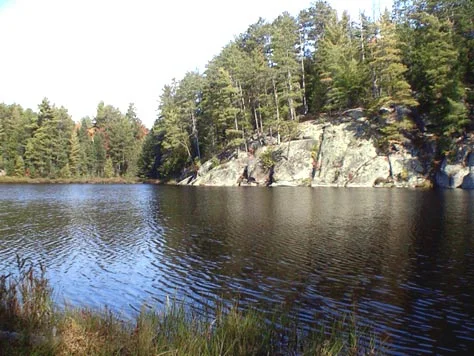
Our developers chose the location for several reasons, not the least being the stunning scenery, which is even more beautiful in the fall. With clear blue skies and incredible colors, it was an unforgettable experience. Perhaps the most surreal experience is listening to the loons. My ever patient brother-in-law spent hours on Little Joe Lake patiently filming a surprisingly bold loon, capturing its eerie cry on tape.
Get the Flash Player to see this content.
As the name implies, Cloud Lake is at a fairly high elevation on the Centennial Ridges Trail, so it was a somewhat challenging climb for my poor old body, but worth every aching bone! Our goal was to secrete a metal box with several copies of The Digital Field Trip to The Wetlands for intrepid geocachers to locate using GPS technology. If you do not know about geocaching, check out www.geocache.com – it is a great way to discover out-of-the way gems that most people never find and a fabulous way to teach children about geography and nature. And plan to visit Cloud Lake soon. We intend to keep the cache stocked with CDs.